
Best Reef-Safe Sunscreen: What to Look For & Why It Matters | Goodspread
Jun 02, 2026
Best Reef-Safe Sunscreen: What to Look For & Why It Matters
'Reef-safe' is one of the most searched terms in sunscreen — and one of the most misunderstood. Walk into any drugstore and you'll find dozens of bottles with 'reef-safe' on the label. But here's the problem: there's no regulated definition of the term. No governing body that checks whether a sunscreen actually qualifies. That means companies can print 'reef-safe' on the label and it might not mean much at all.
So how do you find a sunscreen that's genuinely safer for the ocean? Here's what the science says — and what to look for.
Why Regular Sunscreen Harms Coral Reefs
Most conventional sunscreens contain synthetic chemical UV filters — the most common being oxybenzone and octinoxate. When sunscreen washes off in the ocean (which happens every time you swim), these chemicals enter the water.
Research has found that even tiny concentrations of oxybenzone can cause coral bleaching, damage coral DNA, and interfere with reproduction in marine organisms. The impact is severe enough that Hawaii, Key West, the U.S. Virgin Islands, Palau, and several other destinations have outright banned these ingredients in sunscreens.
What 'Reef-Safe' Actually Means
There is currently no single legal definition of 'reef-safe' in the United States. However, the most commonly cited benchmark is compliance with Hawaii Act 104, which bans sunscreens containing oxybenzone and octinoxate.
A genuinely reef-safe sunscreen should:
• Be free from oxybenzone and octinoxate (the two most harmful to reefs)
• Avoid other chemical UV filters including homosalate, octisalate, and octocrylene
• Use mineral UV filters — specifically non-nano zinc oxide or titanium dioxide
• Use non-nano particles — nano-sized zinc oxide can penetrate coral tissue
What to Look For on the Label
When evaluating a sunscreen for reef safety, ignore the front of the bottle and read the active ingredients:
• Good: Zinc Oxide (non-nano) — the gold standard for reef-safe mineral protection
• Good: Titanium Dioxide — generally considered reef-safe
• Avoid: Oxybenzone — banned in Hawaii and most reef-protected destinations
• Avoid: Octinoxate — also banned under Hawaii Act 104
• Avoid: Homosalate, Octisalate, Octocrylene — increasingly restricted and linked to environmental concerns
Why Goodspread Is Genuinely Reef-Safe
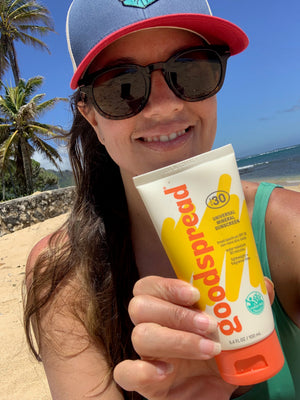
Goodspread is formulated with non-nano zinc oxide as the sole active UV filter. We do not use oxybenzone, octinoxate, or any other chemical UV filter. Our formula is designed to be compliant with Hawaii Act 104 — and we continuously monitor evolving research and regulations to ensure our products meet the highest environmental standards.
Beyond reef safety, Goodspread is fragrance-free, 100% vegan, cruelty-free, and designed for all skin types. Because protecting the reef and protecting your skin shouldn't require a compromise.